Showing posts with label V8. Show all posts

Friday, March 15, 2013

BMW X6 2013

Clique para ver em alta resoluçãoObservar os lançamentos do mercado automotivo nos últimos tempos tem estimulado muita gente a proferir uma frase digna de provocar as maiores doses de agonia nos profissionais do design: “os carros estão todos iguais”. Infelizmente existem mesmo alguns exemplos que validam esta afirmação quando vistos em certos ângulos, mas os que realmente merecem atenção estão no extremo oposto. Um destes ícones mais recentes do estilo automotivo é este crossover cuja nova fase acaba de desembarcar no Brasil.

Comercializado no Brasil pela Eurobike, o mérito do X6 não vem apenas de atrair muitos olhares porque isso se obtém mesmo com carros de aparição mais comum. Sua diferença está em ser um daqueles automóveis que prendem o olhar mesmo das pessoas que não têm tanto interesse nestes produtos. É muito fácil se deter por alguns minutos observando em primeiro lugar os padrões diferentes de formas e volumes, culminando na clássica dúvida entre ele ser um utilitário ou um cupê. Essa curiosidade vem do contraste que a BMW exerceu com muito êxito, ao partir de traços imponentes e volumosos que poderiam gerar qualquer crossover atual (como o próprio irmão X5, por exemplo), mas aliá-los a uma queda de teto digna de um fastback. A outra parte deste encanto dos observadores se expressa em que passar tempo olhando o carro de um lado a outro só melhora a impressão que se teve de início. Não existe um só detalhe que pareça ter sido esquecido, ou recebido menor atenção. São vários vincos e relevos conectando uma forma à outra, criando um conjunto tão fortemente relacionado que entra no clube de exemplos como as fases atuais de Fiat Bravo e Ford Focus: com eles é melhor esperar a época de trocar o modelo por inteiro, porque executar redesenhos parciais sempre tiraria o equilíbrio do design original.

BMW X6Talvez seja esta a razão de o exterior do X6 2013 não ter trazido mudanças maiores que parachoques re-estilizados e novos farois, que não têm problemas em conseguir a intenção de atualizar o modelo para a segunda etapa do seu ciclo de vida – este crossover foi lançado mundialmente em 2009. Quem teve mudanças maiores foi o interior, cuja maior evolução foi eliminar o túnel da transmissão, o que traz o sempre desejado assoalho plano na região do banco traseiro, criando espaço muito melhor para o quinto ocupante. É este banco que também teve o seu reprodutor de DVD trocado, com a tela ganhando posição central. Isso termina de compor uma cabine recheada do nível de luxo e tecnologia típico dos carros desta categoria, cujo console central traz o mesmo padrão de estilo dos demais BMW e também as várias opções de cor, para combinar com os também diversos tons de couro dos bancos em várias possibilidades. As unidades do novo X6 que vêm ao Brasil estarão disponíveis em duas versões: começando em R$ 344.950, a xDrive35i usa o 3.0 biturbo de seis cilindros, que gera 306 cv. Quem quer ainda mais força pode levar a xDrive50i, responsável pelo 4.4 V8 que passa dos 400 cv e eleva o preço a R$ 414.950.

Read more > BMW X6 2013

Land Rover Range Rover 4

Land Rover Range Rover AutobiographyInovação é uma parcela muito grande do conjunto de estratégias de qualquer empresa que tenha pelo menos um mínimo de participação no mercado, mas ainda mais importante que ela é a adaptabilidade. O ato de reconhecer que a vontade do público não só muda com muita facilidade como o faz em uma infinidade de formas. São tantas que várias vezes incluem até mesmo não mudar. Este é apenas um dos intrigantes paradoxos que vêm garantindo o inquestionável sucesso deste fascinante SUV inglês por mais de quatro décadas.

Em outras palavras, essa questão consiste no contraste de vontades vindo da maioria dos clientes com o costume de buscar as opções mais recentes de um produto desejado exercido ao mesmo tempo que preservam certas preferências por muitos anos sem a menor possibilidade de troca. O mercado de perfumes femininos, por exemplo, vende uma série de marcas e modelos mas ainda tem Chanel n° 5 entre os líderes, por várias décadas consecutivas. Situação parecida acontece com Coca-Cola, Nestlé e várias outras, em geral uma marca por segmento. É exatamente isso que mantém a demanda pelo Range Rover inabalável desde os anos 1970. Rivais vêm e vão com os conceitos mais diversos e das mais variadas marcas – incluindo a própria Land Rover, com o Evoque – mas a demanda pelo “Rolls-Royce do fora-de-estrada” permanece sem se abalar. Este aparente paradoxo se torna especialmente interessante porque na verdade é composto por outro paradoxo: se a estratégia simbolizada pelo epíteto mencionado seja seguida atualmente por uma variedade enorme de modelos, quem a criou foi o próprio Range Rover. A receita de tanto sucesso é associar a cabine digna de uma limusine a preparo mecânico suficiente para permiti-lo trafegar nos mais diversos tipos de terreno e com os climas mais adversos sem perder a elegância.

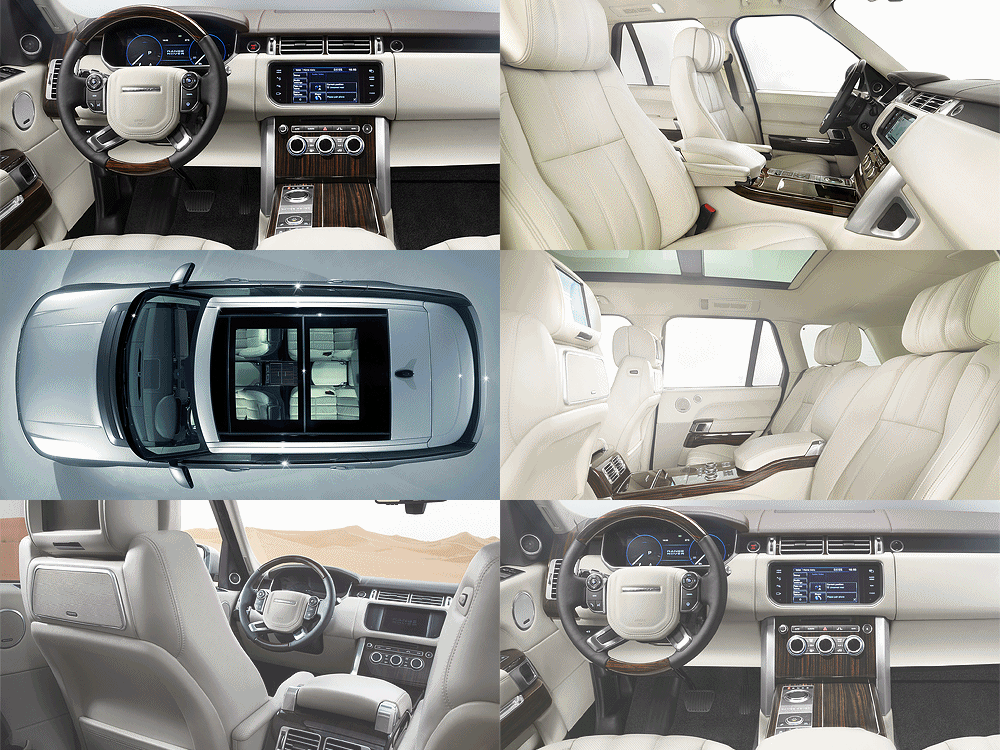
Falar em elegância pode fazer com que muita gente logo lembre dos farois e lanternas claramente inspirados nas luzes do Evoque, mas o fato é que a personalidade do irmão maior é muito mais profunda. Outro símbolo que provavelmente nunca vai mudar é a silhueta do Range Rover, mesmo que a combinação de teto com queda leve associado à traseira inclinada tenha tido seu auge na época da primeira geração. Esta parte guarda um detalhe interessante, aliás: enquanto vários hatchbacks exibem o chamado “teto flutuante” como um detalhe de estilo recente, o SUV inglês já podia trazer todas as colunas em preto desde a primeira geração, obtendo exatamente o mesmo efeito de fazê-las parecer unidas às janelas como um só elemento em preto brilhante, que ao não impedir o teto de manter a cor da carroceria faz este último parecer visualmente desconectado da mesma. Mas assim que você tiver conseguido desviar o olhar do incrível equilíbrio entre passado e presente que é o design exterior deste veículo, começa o momento de estender o fascínio ao interior. A fartura de espaço para cinco pessoas foi exaltada com o aumento de entre-eixos em relação ao antecessor, além de o revestimento em couro se oferecer nos mais variados tons para combinar com a igualmente ampla oferta de tipos de madeira, tudo para compor o ambiente que mais agradar ao abastado proprietário.

Passar à parte técnica do novo Range Rover sempre merece a menção da sua nova plataforma, que recebeu aumento na tecnologia embarcada para não só ganhar em resistência como também para uma excelente perda de peso, que em certas versões chega a 400 kg. Uma novidade ainda mais surpreendente é a evolução do sistema Terrain Response, que abandona a necessidade de o motorista alterar o modo de direção: agora é o próprio veículo que avalia a condição do terreno em que está para escolher os parâmetros mais adequados de estabilidade, suspensão e tração. Em paralelo, o interminável pacote de equipamentos inclui mimos extremos como quadro de instrumentos feito por uma tela LCD e o reprodutor de DVD para os passageiros do banco traseiro. As opções de motorização mantêm o câmbio automático ZF de oito marchas para todas as versões, que no Brasil começam com a Vogue 4.4 V8 biturbo movido a diesel, com potência de 339 cv e torque de 71,1 kgfm e preço de R$ 551.800. Ele também equipa a Vogue SE sob o preço de R$ 575.800 e a topo-de-linha Autobiography, que por sua vez fica em R$ 596.800 – este trem-de-força lhe faz acelerar de 0 a 100 km/h em 6s9 e chegar à velocidade máxima de 217 km/h. Porém, quem desejar força ainda maior pode trocar o diesel pela gasolina que move o 5.0 V8, responsável pelos 510 cv e 63,5 kgfm e pelo desempenho de 5s4 e 225 km/h, este com limite eletrônico. Esta unidade equipa as versões Vogue SE Supercharged, de R$ 583.800, e Autobiography Supercharged, de R$ 601.400.

Read more > Land Rover Range Rover 4

Monday, March 4, 2013

Holden Ute VF

Click to see in high resolutionThe Commodore family wouldn’t be complete without the VF facelift being extended to what must be one of the most charismatic Australian cars. Like what was mentioned on Calais’ article, these cars represent why prospering in the car world isn’t done neither with only global or only regional projects, but using a combined strategy. Ford has followed this concept at that market using Falcon, which has been this family’s archenemy for decades. So now you’re about to read the latest chapter of this delicious competition.

Even though the market has received many new categories in the last years, such as four-door coupés, retro-inspired compacts and the endless variations under the “crossover” label, their purposes may be very different but the history is usually the same: one particular automaker found a gap of the demand that no one was satisfying directly and released a very different car which, according to its intentions, the public would prefer instead of the existing ones. Some ended failing, but others achieved so much success that soon became followed by the rivals. However, other categories were created by clearer demands, such as the Brazilian compact pick-ups: in the 1970s, this market’s commercial sector had only s-size trucks or big pick-ups. The exception came with an adapted version of Fiat 147, whose reduced size gave it excellent handling in city streets, along with the much better fuel consumption of an urban car – the hatchback was already very commended for its frugality. The Australian situation was very similar, in fact: that public wanted smaller pick-ups, although not as much as the Brazilians’, but also taking the advantages of being derived from urban vehicles: it was possible to share most of the mechanics and even several visible parts, such as the interior’s front part, resulting on unusually attractive commercial cars.

This article will be updated when more pictures are revealed.Besides the size, another big difference between those regional trends came with the time passage: while the Brazilian pick-ups wanted to resemble the big sisters, using off-road-inspired accessories, the Australian preferred looking as similar to the urban siblings as they could possibly be. Holden Ute’s last generations are a nice example of that: the big length is “disguised” by very clever styling, with items such as curving the cabin’s external silhouette so it looks longer, using a narrow auxiliary window to “disguise” the sedan’s carried over front door’s “incomplete” design, or taking the wagons’s wheelbase: it avoids a new project’s costs, and having the rear axle very far from the rear end doesn’t leave too big plain areas on the sides – Falcon uses the same solutions. They have some restrictions, like when didn’t accept well the double-cab Crewman, but this public’s overall reaction is impressive, reaching the point of approving a vehicle as picturesque as One Tonner. Holden began to present the latest Ute in the upscale version SSV, which means it has the exact same front fascia as Commodore, but looking very much like an aftermarket-tuned pick-up. There are all the sedan’s aerodynamic and styling kits, while the interior keeps the excellent news by being an exact copy until the front seats. This car is also expected to arrive in June, receiving the 6.2-liter V-8.

Read more > Holden Ute VF

Sunday, March 3, 2013

Holden Sportwagon VF

Click to see a rear pictureIt was a matter of short time. The Australian automaker decided to reveal each sibling of this family at once, and now it’s the gorgeous station wagon’s time. Sportwagon enters the VF phase with the same attractive front fascia debuted on the Calais sedan, but carrying over the side and also the rear sections, although they really didn’t need to change – it’s impressive how a well-proportioned design can make even luxury wagons look nimble, despite this one’s 13-ft length. This car is expected to arrive in June, with V-6 and V-8 engines.

Read more > Holden Sportwagon VF

Wednesday, February 27, 2013

Chevrolet SS

Click to see in high resolutionTaking measures to protect the environment has already become an important part of many people’s everyday. There is at least one task that can be added to any lifestyle very easily, but the problem comes when they attack what a person likes best – like making car fans drive electric or hybrid vehicles. The prevailing attitude has been to accept the ecological cars, but we’ll always have that hidden thirst for speed produced by big gasoline engines with their irresistible sounds. This sedan is GM’s latest way of quenching it.

Yes, if you integrate the team who defends efficiency and low-polluting need to be every car’s concerns, unfortunately you won’t like this one. SS is the result of Chevrolet’s wish of a performance-focused sedan, which means having not only a powerful engine but also the whole concept dedicated to this, which finds response also in the sporty design and exclusive structural characteristics such as the rear traction. GM has essentially rebadged the recently showed Holden Commodore VF to the North-American brand, just like they did in 2007 with Pontiac G8. In fact, the latter only had to be dropped due to the 2008 crisis, which made GM reorganize its entire line and cut even entire brands. Pontiac’s end couldn’t avoid taking G8, but there was always a rumor that something would be done to sell this car in North America once again. The older came from Commodore VE, but this and VF are nothing but different phases of the Australian’s same fourth and current generation – VF must’ve been projected considering SS since the beginning, because Chevy’s car was released only few days after Holden’s. It is true that those cars use an aging platform that will be completely dropped in some years, but it’s also the best solution for now. The Australian division has made a huge evolution when it comes to technology and performance, including retuned chassis and new electrical architecture.

Chevrolet SSIn other words, the covered parts were as refreshed as the exterior, which dropped the 2000s’ typical straight creases and lines for a much more elegant design, characterized by more imponent shapes and smoother volumes – to be more specific, SS is the rebadged version of Holden’s SSV version, not Calais. Chevrolet’s influence is noticed at the dual-cockpit interior, but also in the huge touchscreen’s infotainment system: MyLink is only one item of the large list which includes stitched-leather seats, Bose sound system and even automatic parking assist, with the optional power sunroof. What the attractive black, chrome and red decoration doesn’t show, though, is SS’s top-notch powertrain: the rear axle will be powered by Camaro’s LS3 6.2L V-8, delivering 415-hp power and 415-lb-ft torque, which takes it very close to the new Corvette Stingray. The six-speed automatic transmission will help SS to achieve the announced 5-second 0 to 60 mph acceleration, while the stopping will be credited to Brembo brakes (front rotors with 14” and rear with 12.8”), everything running on 19” wheels and Bridgestone tires (245/40 and 275/35, respectively). SS received the entire latest collision-prevention equipment, but the technology didn’t reached too much under the hood: there aren’t direct injection, cylinder deactivation or variable valve timing. After all, everyone’s entitled to remember once again the good old times of “there’s no substitute for cubic inches”.

Read more > Chevrolet SS

Monday, February 25, 2013

Linha BMW e Mini 2013

Clique para ver a galeria de fotos no FacebookComo a marca alemã foi habilitada no programa Inovar-Auto, iniciar a construção de uma fábrica no país livrou a BMW do IPI de 30%. Os descontos também valeram aos modelos da Mini, mas o repasse não foi uniforme – o modelo de entrada, 116i, ficou R$ 15 mil mais barato, enquanto a Série 7 não teve alterações. Outra novidade é que a Série 6 trocou a versão 650i pelo novíssimo 640i Gran Coupé, mas você pode conferir a tabela completa na galeria do Facebook, que se pode acessar clicando na imagem ao lado.

Read more > Linha BMW e Mini 2013

Friday, February 22, 2013

Holden Commodore SSV

Click to see a front pictureThis one is for those who liked the VF Australian sedan unveiled just a couple of days ago, but would really prefer to change Calais’ black-tie to a more casual luxury. The sedan once again honors Holden’s sporty version, so that’s why there are beautiful wheels matching exclusive bumpers, which have bigger intakes and two twin exhaust pipes. The interior shares Calais’ top-notch equipment list, but coming in a black-with-silver combination only broken by the red lights. This car is expected to share Chevrolet’s V8 6.2L.

Read more > Holden Commodore SSV

Saturday, February 16, 2013

Holden Commodore VF

Holden Commodore VFEven though every market has very particular preferences when it comes to cars, some result even more interesting to observe than the others. Australia and Brazil, for example, have very different cars but coincide in some aspects, such as creating their own categories (and turning them very successful) and receiving almost as many foreign projects as having domestic ones being exported. So before this sedan appears as North American Chevrolet’s new s-size, how about knowing what its homeland has just revealed?

Just like Ford with Falcon, GM’s Australian division has been selling Commodore with great numbers for many years. Holden has taken inspiration some times from Chevrolet and others from Opel, but always resulting at an excellent car which could easily be sold anywhere else – the last two generations, for example, went to Brazil as Chevrolet Omega. But if the Europeans are used to reduce the cars’ updates only to half-life facelifts and new generations, and North Americans receive several tiny updates between the bigger changes, the Australians extend a car lifecycle by creating some partial restylings each two or three years; the third Commodore, alone, had three of them in about ten years. The current phase debuted in 2006, but the bigger time lapse until its first update is probably explained by the very big initial budget spent on attending the public’s very high expectations. The codename VF, comes as a more important facelift because it might be the only one: GM is planning to create a whole new Commodore for 2016 underpinned by a whole new global platform. However, since this will take a long time to happen, for now it’s possible to to appreciate what is certainly this car’s best moment ever. The excellent first impression was guaranteed by starting with Calais, which is this car’s upmarket version. That’s Holden’s way of showing everything its sedan is capable of.

Holden Commodore VFThe external pictures start to show that Holden managed to refresh this sedan making it so attractive that could easily be mistaken for a new generation. The overall impression is that it abandoned the 2000s style trends in favor of a more European inspiration, giving away the sharp cuts and creases in exchange of smoother volumes and much more classy elements. In fact, there’s no wonder why this car has been exported as Opel Omega’s equivalent: VF really resembles Insignia, not a direct competitor but as a bigger brother, because it’s more opulent. But the many similarities are there, specially related to the implicit sportiness given by the irregularly-shaped lights and the very discreet creases. Entering the car reveals a whole new cabin, with seats, doors and console matched in a very elegant two-toned decoration. But the even better news are located at the items list: like every true luxury version, Calais can bring heads-up display, GM MyLink infotainment system, parallel and 90-degree parking assistance, electric steering and several safety systems, to prevent front and rear collisions at low speed, involuntary lane changing and to improve external visibility. Engine data wasn’t revealed so far, but it’s expected that Commodore’s biggest changes will be efficiency improvements, rather than engine changes. This new phase will also generate the other versions, such as Berlina, Omega, HSV, SSV, SV6 and Z-Series.

Read more > Holden Commodore VF

Wednesday, February 13, 2013

Toyota Tundra 2014

Click to see in high resolutionOnce again the North-Americans prove their love for pick-up trucks. The last months saw almost all of the best-selling competitors receiving important updates, either total or partial, with the other ones announcing theirs for soon. So after seeing Chevrolet, Ford, GMC and RAM’s updates and before Nissan’s, now it’s Toyota’s time to reveal its refreshed vehicle. Between all the carried-over items and the also many changes, the automaker has reinforced Tundra to keep defending its sales from this very ferocious market.

After arriving around the 1980s, the Japanese automakers took some time to adapt themselves to the North American preferences when it comes to cars. Those excessively neutral cars never achieved the biggest sales, but between this or taking their domestic cars, they made the best decision for that initial moment. Therefore, the following decade had Mitsubishi, Honda, Nissan and Toyota releasing successive attempts of “fitting in”, some of them becoming successful and others not. It was, actually, a matter of discovering that success would come with projecting with specific focus on that market and later applying the Eastern idiosyncrasies, rather than the other way around. This is exactly what made Tundra’s predecessor fail, in fact: T100 was intended to be a s-size truck, but didn’t have the same level of size and powertrain of its competitors. But, once again, all this learning helped the automaker to create a much better product to succeed it. Tundra still was smaller than its competitors, but became well-accepted by many other aspects, such as the V8 engines. It was only the second generation that received the so awaited bigger size, along with better engines and a series of details that finally managed to stabilish this car’s dedication to work, like having handles and internal controls big enough to be operated with gloved hands. The current restyling only preserved this potential, and dedicated itself to only adapt Tundra to the big trucks’ latest trends.

Toyota TundraIn other words, like Silverado, Toyota’s pickup had design enhancements to became “urban-elegant”, with square lines to bring an imponent impression, along with big wheels and not so many chrome details to make it classier. The two first trims will be SR and SR5, but even focusing at work, they feature an entirely redesigned cabin, with more attractive design and a great equipment package: between standard and optional items, this car can bring ABS, Bluetooth, reverse-gear camera, stability control, 18” wheels and blind-spot monitoring, start/stop and rear cross-traffic systems. Limited adds leather coating and Platinum finishes with higher-quality leather, 20” wheels, JBL sound system with twelve speakers, GPS navigator and Entune, Toyota’s infotainment system. There’s also the 1794 Edition, which is basically a Western-themed Platinum: brown leather, faux suede detailing and the exclusive wheels and external brown painting – besides, each trim now brings an exclusive front grille design. It’s the same piece, but receiving different paintings and designs turned out a very good way to make them take the attentions separately. There will be three cab styles, all with rear or four-wheel drive. The powertrain starts with the V6 4.0L with 270 hp and 278 lb-ft and five-speed automatic gearbox, while the intermediate versions bring a V8 4.6L with 310 hp and 327 lb-ft and the upmarket trims raise power and torque to 381 hp and 401 lb-ft with a V8 5.7L, the last ones with an automatic six-speed transmission.

Read more > Toyota Tundra 2014

Sunday, January 27, 2013

Audi RS7

Click to see in high resolutionDo you remember what Audi used to do with its sporty line until the early 2000s? The only odd-numbered vehicle was A3 which, in turn, was also one of the Germans’ three “exceptions”: A2 never achieved success and TT seemed to be enough among the sports cars, so the several S-number were only sedans and wagons and there was only one RS at a time. The current market has brought enormous changes to this brand’s showroom, though, and one way of illustrating this event is presenting this article’s vehicle.

There’s no argument that Audi can create really good cars, but this one can also be seen as a very accurate example of how the automakers are always getting divided into two groups: it starts when someone comes up with some kind of innovation, whether in luxury, mechanics or even a whole car concept. If it obtains good acceptation, this brand can enjoy some months of excellent sales exclusively for itself, but soon all its competitors start to release their versions of the same idea. Some better than the original and some worse, but all with the same essence, which leads to divide the customers once again. This is what Audi has been doing with its cars for some years, in fact. They’ve followed BMW and Porsche with a luxury crossover and later with creating smaller sizes of it, and also Mercedes-Benz with both the four-door coupes and its own supersports line. Besides, after A7 received the always-expected S7 trim, now it’s time to copy every single urban Audi but A8 and release a RS7. Sports versions are always great, but the problem with this one is that Audi is decharacterizing it. The original strategy was always to give huge powertrain upgrades with slightly visual changes to its urban cars but as the S version, leaving RS as one single very special car like RS2, the very first of them. However, since today almost every Audi offers both sporty versions, they both seem pointless.

Audi RS7After all, the customers who look for high performance cars at Audi’s price range wouldn’t take the “second best” trim only to avoid the price difference in favor of S. On the other side, there are so many RS cars that they’ve lost that uniqueness which in 1994 made that wagon worldwide famous. In other words, it would make much more sense to go back to offering only one line… just like BMW M or Mercedes AMG, by the way. Strategy issues aside, RS7 is the very latest Audi to receive the best performance upgrades these Germans offer. This aggressive design packed with beautiful 20” wheels really go much better with the casual very-high-end Audi than with its sedan sibling A8, also because now there’s a competitor for CLS 63 AMG and the recent M6 Gran Coupé. The driving can be customized with optional air suspension, sports rear differential and variable-ratio steering, stability control with sport option and “off” button and many others, making an already indefectible driving more suitable to each driver’s style. The common item is the twin-turbo V8 4.0L shared with RS6 Avant, delivering here 560-hp power and 516-lb-ft torque commanded by ZF’s eight-speed automatic transmission and quattro AWD system – this car goes from 0 to 60 mph in 3s9. The top speed, in turn, varies with the optional item packages which bring several improvements in style, handling and aerodynamics… and take the car from the 155-mph top speed to 174 mph or 190 mph.

Read more > Audi RS7

Saturday, January 19, 2013

Chevrolet Corvette C7

Click to see in high resolutionHere it is. After several months of spied prototypes, leaked pictures of external parts and related material, some official teasers and dozens of computer projections, this is the real deal. Corvette has become one of the most famous symbols of North-American vehicle performance of all times, so its fiftieth birthday deserved that Chevrolet once again faced the task of not only improving this car in every possible way but also of finding the right way to do it. The meaning of this expression is what you’ll discover with this article.

Chevrolet’s task is even harder than Ferrari’s, for instance, because the traditions it maintains are heavier. Some of the sports cars automakers have built their reputation around several vehicles, like the mentioned Italian one, but there are others which prefer to dedicate themselves to improving one single car over the years. These are exactly opposite strategies, but the chances of success and failure are the same for both – it only depends on their execution. Corvette is an undeniable example of the second one, just like 911 is for Porsche. And also like with the German coupe, dealing with such a huge tradition became a true challenge for its brand because whenever it’s time to perform changes the same question appears: “Would it be better if it looks like the previous generations, or is it time to create a whole new car?”. Nevertheless, the last years showed that while the European sports cars started to focus at the future, with new design languages and even new car categories, the North-Americans decided to work looking back. The 2000s were s of past-inspired cars like Chevrolet SSR and Plymouth Prowler, and some of them resist until now: once again it’s possible to decide between Chevrolet Camaro, Dodge Challenger and Ford Mustang and notice that all of them expose retro designs. So it turns very surprising to observe that Corvette wants to break this “rule”, like Dodge has recently done with their own super sports car, SRT Viper.

Chevrolet Corvette C7 1Some people won’t take long to claim the seventh Corvette looks too much like the new Viper. Others will go further by remembering that since Viper received some criticism of becoming too European, Corvette would have become an US-made Ferrari. But the fact is Chevrolet decided to express this car’s big traditions in a less obvious way. Investing so hard at resembling forty, fifty years old cars reduces the designing freedom, therefore avoiding to improve the car’s performance – which is an extremely important aspect for a sports car. So the new Vette became more aggressive, with plenty of strong creases and a beautiful selection of acute-angled shapes, which all contribute to a very modern look, much different from the smooth lines seen until C6. But the mentioned past references are still easy to observe: the front is elevated at the center but even more at the extremes as in C3, but with the headlights far from the center, as from C4. And the rear windshield creates a triangular shape that ends at an abruptly cut rear only reminds what’s seen since C2. The tail lights, however, brought a fascinating combination: they still use double units like in every Corvette, but lost the round shapes in favor of rectangles, to go better with the overall style and resemble Camaro. Even the front grille’s chrome line could give a hint of Chevrolet’s current design language for this item.

Chevrolet Corvette C7 2Looking to this car’s roof is another interesting ambiguity, in fact. Although the black spot here means a removable roof, having it next these black-painted A-pillars makes it impossible not to remember the 1990s futurism of Lumina APV. The other meaning is that roof represents the cutting-edge technologies received by this car. The console uses a modern interpretation of Corvette’s typical driver-centered interior design, now filled with some aluminum and carbon fiber details and several coating options. The big touchscreen summarizes that this car now brings all the current trend items, like multimedia sound system, and it’ll be possible to choose between comfortable daily-use seats or competition ones. Even the quickest glimpse at the tech specs sheet will reveal enormous structural improvements, which managed to improve aspects like body stiffness and weight, Brembo braking system, suspension, wheels (with specific tires) and efficiency. C7 Vette proves it deserves using the Stingray name also with the powertrain: the naturally-aspirated small-block V8 6.2L hasn’t left the front section, and produces 450 hp and 450 lb-ft of power and torque. It’ll also features cylinder deactivation with active exhausts system as a standard item – using an automatic six-speed transmission or the manual seven-speed gearbox, the result of all that is a 0-60 mph done in about four seconds and better emissions and consumption rates than C6’s. Pretty good use for those four exhaust pipes, right?

Read more > Chevrolet Corvette C7

Wednesday, January 16, 2013

Mercedes-Benz CLS 63 and E 63 AMG

Click to see E63 AMG Sedan and EstateSports car fans have been delighted with high-performance versions of conventional cars for decades. Audi S and RS, BMW M, Chevrolet SS, Dodge SRT and R/T, Fiat Abarth, Ford ST, Volkswagen GTI… There are lots of examples around the world, but they’re only different ways of achieving the always impressive balance between all the sportiness of coupes and convertibles and the particular features of each car which receives them. So how about meeting not one but four of the best sporty versions of the entire world?

Although there are lots of enthusiasts that cheer with each and every car release of nowadays because they know the quality level involved, there are lots of people that still ask themselves “Why do they have to create so many vehicles? Why can’t they only stick to improve what they already have?” and other similar questions. On the other side, this blog and the entire specialized press have written so many times about the increasing need to find new markets in order to keep offering competitive products that it won’t take too long for us to run out of different ways of rewriting the same information. Nevertheless, this blog doesn’t even think of stating that as criticism because it recognizes that it doesn’t take more than a moment spent thinking as a “car fan-but-not-freak” to realize that it is really hard to notice all of this conceptual information delivered at these texts. There are many pictures of the article’s car, but also many paragraphs referring to lots of other cars, turning it very difficult to only imagine all that. Since this blog always tries to go beyond one more plain repetition of each release’s features, these four cars have been referred in this single article in order to receive also a brief illustrative comparison. The first animated picture displays the new CLS 63 AMG at its Coupé and Shooting Brake versions, while the second one shows the facelifted E-Class Sedan and Estate now as E63 AMG.

Mercedes-Benz CLS 63 AMG Coupé and Shooting BrakeIf you were guessing the first mentioned aspect would be the external design, you’re right. There’s no way to avoid it, in fact. The main guideline that inspire these cars’ differences is the ability of each one taking a particular customer, reducing the internal competition to its minimum. E-Class has always gone after the more traditional public, which has preferred the same things for decades, while CLS receives who goes to a Mercedes dealer for the absolute quality but would really prefer something different, more casual. The shared platform enables those cars to share lots of internal parts, not to mention the engines, but stays far from being a barrier against their breathtaking conceptual differences. CLS’s four-door rear is only the first symbol of the opposition to E-Class’s three well-divided volumes. And since they both have SW versions, CLS’s interpretation resulted at the Shooting Brake body. E-Class’s sides use more horizontal creases, bringing a solid, classy impression while CLS makes a contrast between the narrow but long lines dying at the rear doors right where the very imponent fender starts, reminding the North-American muscle cars idea of movement. E-Class’s elements take most space of one only side of the car, probably to remind its several previous generations: most cars from the 1970s to the 1990s used a “folded-paper design”, where you couldn’t see much of the headlights, for example, if you were looking to the hood or the sides – CLS’s shapes are much more tridimensional. And since the lights were mentioned, it would be impossible to skip them.

Mercedes-Benz E63 AMG Sedan and EstateE-Class can join them or split them at the front or redesign them at the back in any way, but they will always remind even the 1960s ancestor – so yes, you must’ve already guessed that right: at least until now, CLS preferred to make big changes from its previous generation. Fortunately, both cabins agree at delivering fascinating quantities of sophistication and safety, but this is one of the few truces here. CLS’s cabin is more fluidic, reducing the idea of a rectangular space while E-Class is much more likely to be driven by a chauffeur. The sedans even differ at the seating: E-Class sticks to five seats, but CLS dedicates itself to four. The wagons, in turn, diverge at the trunk: if E-Class is much more focused at the families, its sister’s space is bigger in length and smaller in height, privileging cargo such as golf clubs and hunting guns. Besides the bigger wheels and the more aggressive aerodynamic kit, the AMG version brings the same “heart” for these cars: the final (and most important) truce is the twin-turbo V8 5.5L, with that performance package from before the facelift now offered as a standard item. This means this engine now produces 550 hp of power and 531 lb-ft of torque, always using the AMG SpeedShift transmission: there are double clutch, seven speeds and four driving modes. Besides, these cars use rear-wheel drive or the 4Matic AWD system, but the (even more) special feature is the S package: this new performance kit uses 4Matic and boosts these cars to 577 hp and push the speed limit to 186 mph, with average 0-60 mph times of 3.6 seconds.

Read more > Mercedes-Benz CLS 63 and E 63 AMG

Sunday, January 6, 2013

Mercedes-Benz E-Class Cabrio and Coupé 2014

Click to see in high resolutionSome weeks after the traditional-family versions’ release, now it’s time to get some renewed E-Class to that bachelor uncle, too. It would be a nonsense to hope this facelift would've been applied only to the sedan and the station wagon, but these first official pictures show that Mercedes hasn’t gone too further in some aspects. The bright side, however, becomes very easy to see when we remember their goals here. This article will show why doing this leaves everyone with a “mission accomplished” thought.

It’s very pleasant to see an automaker perform the true interpretation of a vehicle’s version. This consists basically in deciding how far the new option will go from the original one, in order to find a nice proportion of individual personality and physical and/or conceptual resemblance with its own line. In other words, in fact it is possible to visually stretch a hatchback’s lower rear section and create a sedan. Than stretch the upper one too and achieve a station wagon. Take off the rear windows to have a pick-up. Cut them all and the rear doors to obtain a convertible, and cover it all to end up with a coupé… but even the fairly acceptable projects from nowadays already invest much more in differentiation. Therefore, climbing to the Mercedes-Benz level leads to results such as what these pictures show. Okay, the updates have the exact same labels of the four-door versions, such as “new single-unit headlights with LEDs” or “redesigned bumpers”, but it’s interesting to notice how they match the slight visual differences brought by these two. For instance, they feature exclusive rear fenders, with a much more appealing design in order to highlight that these are the sporty E-Class options. Not to mention it enables bigger differentiation from the other Mercedes sports cars: they became more opulent than the two-door C-Class and, at the same time, more classical than CL or SL.

Mercedes-Benz E-Class CabrioThis means presenting more particular designs is only those last mentioned ones’ proposal, which is totally appropriate for them because each one is its entire own line. These Cabrio and Coupé, in turn, show a different interpretation of their E-Class genes: the headlights use the same basic structure but in a more casual design, with irregular shapes and a different LEDs drawing, while the front grille received a bigger and more aggressive design. These differences may seem small, but the fact is they are the true responsibles for achieving what was stated at the last paragraph’s start. It isn’t necessary to invest that much into a vehicle’s new version, but achieving this “new personality” is really useful to attract better sales. After all, if a given automaker sold the exact same car only with more or less doors and with or without roof (like the Opel Corsa or Renault Mégane families in the mid-1990s, for example) there wouldn’t be many reasons to sell a particular one, leading most customers to end up with the biggest or the cheapest one – this situation could be translated into one or two variations selling very well and the others having much smaller numbers. Following the opposite strategy allows the car family to divide their public more equally, because each member brings exclusive details to please only a specific part of those buyers.

Mercedes-Benz E-Class CoupéEntering these vehicles shows smaller updates, such as the redesigned dashboard with a central analog clock and the relocated gear selector, which went from the central console to the between the front seats. As what was seen in the four-door E-Class, there are much bigger improvements at the technical field: the power steering now uses an electromechanical system, which allows a self-parking function. The stereoscopic camera can monitor a much bigger surroundings’ area, the Collision Prevention system is now a standard item, and the optionals list brings a lot of similar technologies, such as lane-keeping, Pre-Safe, adaptative cruise control and the mentioned parking assist systems and 360°-camera. The only AMG-related information released so far is the item package, like what was seen at the new E-Class station wagon and now at the Coupé: exclusive bumpers and wheels are the responsibles of the more aggressive look, but the s-modified versions mustn’t take too long to appear. These cars won’t have lots of surprises about their engine options: they’ll surely maintain the E250, E350, E500 and E550 trim levels, each one with a different engine or a particular engine configuration but always using excellent transmissions, such as the seven-speed automatic gearbox. The complete E-Class will make its official debut at the upcoming Detroit Auto Show.

Read more > Mercedes-Benz E-Class Cabrio and Coupé 2014

Tuesday, January 1, 2013

Aston Martin V8 Vantage

Click to go the photo galleryHow about starting 2013 with a big photo gallery? The last year gave this car some design updates that surely improved its imponent, unmistakable Aston Martin design but focused at the aerodynamics, in order to achieve better driving dynamics. Besides, the entry-level 4.7L V8 has been reworked to become more efficient. It generates 420 hp now and uses a manual six-speed transmission, but offering an optional Sportshift II seven-speed gearbox. Clicking at the picture will take you to more official photos.

Read more > Aston Martin V8 Vantage

Thursday, December 20, 2012

GMC Sierra 1500

Click to see in high resolutionIf Silverado received a new generation, why wouldn’t Sierra? And since they’re twins, why one of them would have to wait more? GM has shown what could be named as good parenting skills, and gave the new generation to both pick-ups at the same time. Besides that, this mother has also realized that they’re no longer a pair of babies, so allowed them to get bigger differentiation – each one has a much more individual design than their previous generations. With all that in mind, how about meeting the second of these siblings?

Badge engineering is a very tricky concept, and you must’ve heard this a lot of times – even without leaving this blog. There are many variables to consider, so using the set A or the set B is the biggest responsible for the car’s success or failure. When it comes to these two pick-ups, this new generation turned Sierra fancier than its sister, not only because of what differences were applied but also for how. GMC’s truck also received the aluminum hood, improved chassis with hydroformed front section, doors which now don’t reach the roof and other items to reduce the weight and obtain better aerodynamics, but the style changes manage to produce great effects without being too extensive. The intention seems to be creating conceptual differences, rather than more explicit ones. The bumper, for instance, is as chrome as Silverado’s, but received a more complex design. The grille must have the same size, but received big frames in order to reduce the size impression. Besides that, there’s a bigger external-color-painted contour around the elements, which helps to visually disconnect the items and gives a solidness impression. But nothing says “this is GM’s fancier truck” better than the headlights: can you notice that they’re shared with Silverado? Well, if at Chevrolet they come in pairs, Sierra avoids the extravagance by bringing only two, and wraps them in elegance with LED daytime illumination.

GMC Sierra 1500GMC also updated Sierra with Silverado’s new safety package, including the camera-based system to prevent forward collisions and lane-keeping system with sound and seat vibration alerts. There’s also electric steering for all versions, in a redesigned cabin whose biggest differences from Chevrolet’s truck are the red details, to contrast with the black and silver of the internal coatings. Sierra also received the latest version of IntelliLink in an 8” touchscreen: it isn’t hard to guess this is nothing more than GMC’s version of MyLink. The bed options depend on the cabin type: extended cab is paired only with the 6.5-feet one, while the regular cab adds only the 8-feet and the crew cab adds only the 5.8-feet, 8-inch option. There are two or four-driven wheels options, and three engines: like what’s seen on Silverado, Sierra now uses a 4.3L V6, a 5.3L V8 or a 6.2L V8, always with a six-speed automatic transmission. Those engines have several technologies to improve the efficiency, such as direct injection and cylinder-deactivation: when riding with light loads, the V6 turns off two and the V8 four of them. In other words, the biggest difference between Sierra and its Chevrolet twin sister is purely conceptual, like two more separate trim levels of the same vehicle. They will hit the streets early next year, but until now there’s no information about the price lists.

Read more > GMC Sierra 1500

Wednesday, December 19, 2012

Chevrolet Silverado 3

Click to see in high resolutionIt’s nice to observe that each country has a very strong connection with a particular car category. The Europeans love hatchbacks, the Australians are crazy about sedan-based pickups, the Brazilians are very fond of sedans… and the North-Americans can’t resist a big, powerful pick-up truck. Their biggest competition is among the mid-sized ones, such as Ford F-150 and RAM 1500. While those needed only slight restyles, it was time for Silverado to receive a whole new generation. And what a great one it is!

These trucks’ sales are so big and stable that they don’t really need to perform big visual changes, since they seem to already have found what their public wants. That’s why, like its competitors, Silverado didn’t make a design revolution from its previous phase. It’s nice to see that it managed to become more modern along with becoming more imponent: the increased fenders are just the right addition to the cleanly-shaped sides, while the rear directs the attention only to the big tail lights and the brand’s logo. But the front is what surely deserves the bigger compliments: not only became tougher with the big grille and the chrome details, as also features a very stylish interpretation of the brand’s classical trucks design: the headlights are also divided in two, just like the 1998 model. But pick-up trucks doesn’t attract clients only with good looks. Silverado’s aerodynamics became much better not only because of the softened design but also because of the new doors, which were improved at fixation and size in order to reduce the internal noise. Besides that, the redesigned chassis uses hydroformed front section and lots of high-resistance steel at the cabin, resulting at a much bigger collision resistance. All of that is offered in Crew Cab and Extended Cab, whose box options go from 5’8” feet to 8’, depending on the cab option.

Chevrolet Silverado 3Another nice feature of the most recent pick-ups is the cabin. Since the 1990s they’ve been receiving so many luxury and comfort improvements that in nowadays it wouldn’t be very hard to mistake them with sedans or minivans. There are several contrasts in this cabin, which are actually very nice to observe: the new dashboard still brings many gauges like any big pick-up demands, but right next to it there’s the new console with a huge touchscreen signing that this car also has the new MyLink entertainment system, packed with multiple USB ports, Bluetooth connection and additional commands at the steering wheel – all the pick-ups have a very wide central armrest, right? Well, Silverado’s is a cover to this very big storage space, divided for fitting smartphones, laptops and other electronic devices. However, none of that has distracted Chevrolet that this is a pick-up truck: the box has LED lights beneath the rails, its corners have built-in steps for easier access and a great safety pack: there are electric steering, four-wheel disc ABS brakes, forward-collision-warning system with cameras and lane-keeping system with seat vibration and audible alert. All of that moves with the Ecotec3 engine family: direct injection and variable valve timing are some of the components used in the three available options. There’s a 4.3L V6, 5.3L V8 and 6.2L V8, all of them with cylinder deactivation when with light load.

Read more > Chevrolet Silverado 3

Tuesday, December 18, 2012

Mercedes-Benz E-Class 2014

Click to see in high resolutionWhen it comes to selling cars, building traditions can be as tricky as not having them. Some brands decide to keep a successful concept over the years only performing updates, while others prefer fresh starts for each time they have to replace a vehicle. These strategies are equally capable of leading both to success or failure, so each case must be considered individually. Mercedes-Benz has decided to follow the first path decades ago, so each time it becomes more impressive to see how they manage to keep this success.

Creating an entire new idea for each generation of a given car allows the brand to adapt it with the current times much easier, such as what Fiat has done with their medium-sized hatchbacks: Tipo’s straight lines were very common at the late 1980s, but when the following decade’s trends became to appear they had to respond. This reaction came with not one, but two cars: using two names enabled Brava and Bravo to give much better interpretations of two-door and four-door hatchbacks separately, but both with very creative designs. Later, if the 2000s brought the straight lines back but with more imponent shapes, creating Stilo was much better than discharacterizing the previous cars. And when the car world associated organic lines to a nostalgic trend, Fiat showed a modern reinterpretation of Bravo. Meanwhile, one of the opposite examples can be given with Golf: straight lines, round lines, bigger shapes, organic shapes… Volkswagen did their best to follow each and every trend along with keeping traditions such as the overall shape and iconic details like the “C column”’s big width. Sometimes they did it better and sometimes worse, but it’s undeniable that those years built a very strong image to its customers. Like BMW, Mercedes-Benz follows the traditional path even more strictly – cars like CLS and B-Class are much more younger than E-Class, for example.

Mercedes-Benz E-ClassHowever, the last years have seen some conceptual changes even at this brand’s most classical cars. C-Class used to act as a miniature of the other Mercedes, but it was noticed that there were many possible buyers that didn’t take one because of the high prices and the “too classical” style. So the Germans decided to create cheaper versions, but along with a “cooler” design, much more casual than the previous generations. On the other side, S-Class now needs to fill the late Maybach’s gap at the very high luxury market, so what’s left for the middle brother? This facelift proves that the answer must be to stick to the tradition: apply the best current technologies to improve an already well-stabilished car. The new headlights could be a nice example of that: they’ve turned into an only piece for the first time in eighteen years in order to receive LEDs illumination, but with a two-parts shape that clearly reminds the previous design. There are several other elements which connect Mercedes’ current cars with the older ones, such as the big front grille with the SLS-like shape or the tail lights with horizontal components. This is only a half-age facelift, so the Germans wanted only to rejuvenate it. It’s easy to see that this mission was accomplished because both sedan and Touring versions now give a more dynamical impression, obtained with slightly bigger elements and less lines.

Mercedes-Benz E-Class TouringNevertheless, a Mercedes would never be a Mercedes if there wasn’t the typical “limousine impression” that has earned so much admiration through the years. C-Class now follows a slightly different path, but E-Class doesn’t make any effort to hide that it is a typical “rich people’s car”. Not that this is a bad thing: there are no doubts that this is one of the most classy cars of its price range. This facelift came with a new dashboard and a new entertainment center which even includes Internet, and finishes to compose a really sophisticated interior, which will pamper its five occupants with lots of luxury items but also with an impressive safety system: there’s active cruise control, automatic lane-keeping, brake assistance and an optional stereoscopic camera on the windshield, that can recognize three-dimensional shapes and movements in order to improve collision preventions. As usual, Mercedes will offer a big variety of engines paired with an even bigger of versions, but no single market will have all of them. Using gasoline, there will be a 2.0 turbo for E200 and E250, a 3.5 V6 with direct injection for E300 and E350 and together with an electric one for E400 Hybrid and a 4.7 V8 twin-turbo for E550, not to mention the also double-turbined 5.5 V8 for E63 AMG – the diesel options must be E250 and E300 BlueTec. Some of those will offer the 4Matic all-wheel drive, but all of them will bring start/stop system.

Read more > Mercedes-Benz E-Class 2014

Monday, December 17, 2012

BMW M6 Gran Coupé

Clique para ver em alta resoluçãoThe German automakers’ tradition with sporty versions became so solid that in nowadays those are expected right after each new release. After all, while the traditional sedans and coupes are supposed to improve what they’ve been offering in all those years, the market can always create some space for new well-accepted cars, even though they would’ve never been thought of four or five years ago. Few months after BMW announced its debut among the four-door coupes, it’s time to quench the public’s second thirst.

This category’s concept is already known: it’s the same luxury and technology wrapped in a much more casual design, in order to please the customers who need a four-door car but would love to distance themselves from that “limousine look” given by most of the luxury automakers’ sedans. That’s what Mercedes-Benz invented with CLS and the VW group repeated with Audi A5 Sportback and A7 and Volkswagen Passat CC. But BMW not only refused to create a four-door of their own at this initial moment, as also seemed to keep being outside it when those two brands presented those cars’ second phases. Considering all of that and remembering that this is the automaker who created X5, X6 and even dared to develop sporty versions for both, it wouldn’t be crazy to expect that those Germans had bigger plans. So they didn’t lose the opportunity to overcome the cars which inspirated this one. Instead of an innovation attempt which could easily be rejected, such as 5-Series Gran Turismo, this new car focused at improving its original concept. There are plenty of sportiness and casuality all over this car, but without relying on a fastback-wannabe rear design. This one looks much more like a casual sedan than a formal coupé, using smoother shapes combined with strong details to give a classy impression – it may become harder to sell M5 from now on.

BMW M6 Gran CoupéThe M version brought very similar changes to what was seen at coupé and convertible M6. There are the traditional exclusive bumpers, side spoilers and fiber carbon roof. But that mentioned “discreet sportiness” can be found at items such as the four exhaust pipes, the black-painted roof or even at the Motorsport division’s logo, discreetly placed at the gorgeous 20” alloy wheels’ center. This proves that M6 paid a lot of attention to the details, instead of only the overall impression. This idea becomes even stronger when entering the car, because BMW didn’t restrict itself to create only one more interpretation of their current interior design’s rules. There still are the big console and lots of other elements that highlight this car’s big width, but it also received details such as Merino leather seats, roof coating using Alcantara, Motorsport’s special steering wheel and much more – another big difference between these cars and the conventional sedans is that these ones’ customers would never hire particular drivers, because they are very aware of the additional driving pleasure found at them. M6 Gran Coupé, for instance, will use the V8 4.4 twin-turbo, with 560 hp and using the M Double Clutch seven-speed automatic transmission. This car also brings sporty suspension and active differential to achieve 0-60 mph in 4s2 and two top speeds: there’s an optional item package which will bring ceramic brake system, multifunctional seats, GPS navigator, Bang & Olufsen sound system… and will raise the top speed from 155 mph to 189.5 mph.

Read more > BMW M6 Gran Coupé

Friday, December 14, 2012

Chevrolet Camaro SS 2013

Chevrolet Camaro SS 2013As novas rodas já antecipam: o muscle car terá pequenas novidades para compensar o preço de R$ 203 mil. As pinças de freio Brembo receberam pintura preta, mas é a cabine que melhorou mais: o Camaro ganhou nova central de entretenimento no painel, com a tela de toque de 7” que controla o novo sistema de som multimídia, a conexão Bluetooth, o reconhecimento de voz e exibe as imagens da câmera de ré. Agora o banco do passageiro também traz regulagens elétricas, e foi mantido o 6.2 V8 de 408 cv com câmbio automático.

Read more > Chevrolet Camaro SS 2013

Tuesday, December 11, 2012

Audi RS6 Avant

Click to see in high resolutionWith all the enormous variety of cars released every month there are also new categories being created, and therefore others falling into inevitable sales ostracism. One of the second kind’s examples are the station wagons: the first attack came with the minivans at the 1980s and twenty years later with the crossovers, each one trying to steal a different part of those customers. There were made speculations of all kinds, but this article’s car is a perfect example of why this category has everything to stay strong for much longer.

Unlike cars such as big pick-up trucks or small hatchbacks, station wagons were always famous in both United States and Europe. They spent about fifty years satisfying people with big families, medium-sized cargo to transport and even younger people who needed a “cooler” car to travel with friends and items such as surfboards. In other words, this car category was the only “halfway” between the good-looking style and the better handling of urban cars and the bigger space and engines brought by small trucks. But those two mentioned younger categories came one focusing at the big families and the other at the light off-road lovers, which couldn’t avoid affecting the station wagons’ market. However, Audi was one of the few brands to preserve these cars by rescuing the aspect that couldn’t be explored by those new cars: the sportiness. Lower external height and bigger construction similarity to sedans and hatches make the wagons much easier to receive high performance versions because it’s easier to share parts with those, and therefore to obtain similar driving behavior. Audi RS2 not only became an icon among the urban sports cars but also changed the world’s vision of its category. In nowadays there still aren’t too many station wagons, but every bigger automakers sell at least one of them. And many of them offer a sporty version.

Audi RS6The following years have received lots of other RS cars, but when it comes to station wagons Audi is currently selling two options – the other one is RS4. The bigger sister has recently catched up with A6’s new generation, which means a strong and stylish design that only escapes from the “looks too much like the other Audis” tag because of the several external aerodynamic items: there are huge front air intakes, gorgeous 21” wheels, side and rear spoilers, silver-painted details and the double exhaust pipe highlighted by the exclusive bumper. Audi may draw their cars too much alike, but it’s undeniable that the bigger ones manage to don’t seem excessively long. Since A8 is sold only as a sedan, RS6 will be their biggest station wagon currently sold, but it still carries a nimble, dynamic appearance. Besides that, it’s easy to see cutting-edge all over it: there are LEDs and more LEDs to compose the illumination, and the great aerodynamics is helped by the lower roof racks seen in the most recent two-volumes Audis. If you’ve already met the new S6, entering this car will give you a strong déjà vu. There are plenty of black, silver and carbon-like details which don’t create an entirely two-toned space because of the red items: this color makes some “cameo appearances” at the dashboard, the RS series’ logotype and some buttons’ lights.

While many cars use more verticalized designs to the interior, it’s interesting to notice that Audi has been following the opposite path. The horizontal lines give a bigger-width impression, along with a lower console in order to maximize the windshield view. This car will bring the highest A6 trim level available, with two optional packages to add luxury items such as 100% LED headlights, bigger touchscreen, Bang & Olufsen sound system and internal coating in carbon fiber or matt aluminum. Opening the hood reveals the new V8, a 4.0 bi-turbo whose only flaw is to have lost 10 hp, offering 560 hp now. No, Audi hasn’t gone crazy. This engine was reprojected to optimize both performance and efficiency, so it ended up much better: the torque was increased and comes much earlier, helping to achieve 0-60 mph in 3s9, always using automatic eight-speed transmission, quattro traction and air suspension – this one can lower the ride height in 0.8 inch when driving at higher speeds. The consumption was improved in 10%, now achieving 23.5 mpg, but the most interesting technical information are three, in fact: as usual, the stock top speed stays at 155 mph, but if you remember, this car will have two optional packages. So how about knowing that the first one raises it to 174 mph… and the other lets RS6 achieve 189.5 mph?

Read more > Audi RS6 Avant
 
 
Copyright © blog
Blogger Theme by Blogger Designed and Optimized by Tipseo